SYNPOL® D
Product Overview
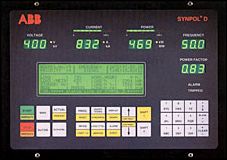
SYNPOL®D is a compact devise used for the control and protection of generators
and deisel engines. In addition, SYNPOL®D is equipped with a power management
system that includes automatic connection to big consumers for controlling the
entire mains systems of marine or land-based power stations. Because of its
modular structure, the system is not influenced by any central control unit.
Since a SYNPOL®D control device is assigned to each generator panel, all
generator panels are identically constructed. A two-wire bus communication (CAN-Bus)
connects the SYNPOL®D control devices to each other. In case of failure
of one device, the others will continue operating. Each SYNPOL®D device
incorporates all important functions necessary for power management. Thus, the
system of independent and autonomous electric diesel engines has been consistently
developed for switching gears, control and monitoring (modular independent systems.)
Optionally, a PC-monitor system can be connected if CAN communication is in
use.
LED Display
A SYNPOL®D device is mounted on the front of the door of each generator
panel. The control panel of the SYNPOL®D device itself contains elements
for displaying all of a generator’s important values. These values, permanently
indicated on the green seven-segment LED displays, are:
- Generator voltage,
- Generator current,
- Generator power,
- Generator frequency,
- Generator power factor.
In addition to the seven-segment displays, a generator’s current and power
are shown by analog indication with continuous green light bands that turn red
after passing the 100% mark.
LCD Display
There is a large LCD display on the SYNPOL®D control panel, which provides
the following information:
- Diesel engine status display,
- Measuring data of generator,
- Display of incoming alarms in case of exceeding value limits,
- Status display of total plant when power management operation is in use,
- Display of parameters and limits for input when the programming mode is selected,
- Status display of internal computers.
Keyboard
All values can be entered via a keyboard on the SYNPOL®D control panel.
Some of the keys are also used for operating the diesel engine, so there is
no need for a separate programming device. The key "Acknowl" serves
for acknowledgment and resets stored alarms.
Special Alarm and Tripped LEDs
Two red LEDs for "Alarm" and "Tripped" are located on the
SYNPOL®D control panel. In case a limit is surpassed triggering an alarm,
the LED "Alarm" will blink. After the alarm time has run down, the
LED "Alarm" will turn to a steady light and remain on until the triggering
value falls below the limit value and the key "Acknowl" is pressed.
If a limit triggering the generator breaker is surpassed, the LED "Tripped"
will blink. After the end of the delay time, the LED "Tripped" will
turn to a steady light and remain on until the triggering value falls below
the limit value and the key "Acknowl" is pressed.
SYNPOL®D Reliability
The SYNPOL®D is controlled by means of several microcontrollers that monitor
each other. Important functions are laid out in a double-redundancy combination,
with the second channel operating independently and without a processor.
The short-circuit protection operates parallel to the microcontroller and does
so even if the entire supply voltage fails.
Terminal Connections
The SYNPOL®D device has several connectors installed on its back that link
it to the terminal boards. These terminal boards are mounted in the generator
panel of the switchboard and are connected to the control unit via terminal
blocks. The cables connecting the terminal boards to the control unit are shielded
on both sides.
The following terminal boards can be connected:
1. Terminal board CMA 131 – Generator connection
2. Terminal board CMA 132 – Generator relay
3. Terminal board CMA 133 – Differential protection and earth-fault monitoring
4. Terminal board CMA 134 – Resistor
5. Terminal board CMA 135 – Diesel start, stop, control and monitoring
6. Terminal board CMA 136 – Communication control
7. Terminal board CMA 137 – Additional functions
8. Terminal board CMA 138 – Special types of control
Generator Protection Functions of SYNPOL®D:
- Short-circuit protection that remains effective even if the entire supply voltage
of the device should fail. Selective disconnection of a faulted generator. Reconnection
protection by manual resetting.
- Three-step overload protection by over-current recording.
- Reverse power protection.
- Three-step disconnection of non-essential power consuming components in case
of overload, under frequency and over current.
- Synchronization of the alternator to the busbar.
- Automatic speed adaptation of the diesel engine to the busbar frequency.
- Under and over-voltage monitoring.
- Under and over-frequency monitoring.
- Open circuit monitoring of the current transformer circuits.
- Asymmetrical current protection.
- Asymmetrical voltage protection.
- Self monitoring of supply voltages and of program operation via Watch-Dog function.
- Active power measuring, including non-sine voltages and currents and especially
thyristor loads (output signal ±10 V/DC or ±20mA/DC intended for
moving coil instrument connection).
- Reactive-power measuring.
- Apparent-power measuring.
- Current output 4 – 20 mA for remote control display.
- Permanent storage and indication of all release functions.
- Supply for the under-voltage coil (direct current), supporting the supply in
case of short-time voltage drop.
- Differential protection with current-adaptive tripping characteristic and minimum-differential
monitoring in case generator is operating at no load.
- Earth-fault monitoring, including phase recognition and minimum-differential
monitoring, in case a generator is operating at no load.
- Counter for the following data: working hour, kWh (dual counter), kvar, start,
and main breaker.
Diesel Control Functions of SYNPOL®D:
- Active-load regulation with secondary frequency regulation, twice controlling
several mains (in case tie circuit breakers are used).
- Power factor in combination with voltage control in several networks.
- Load-free disconnection of the alternator circuit breaker.
- Asymmetrical load regulation, with constant load set point (for example, shaft
generators).
- Asymmetrical power factor control with constant set point (for example, land
stations).
- Start, stop and preglow outputs rated for 24 V/40 A.
- Galvanic separation of I/O’s by optocouplers.
- Galvanic separation of 24 V supply to the engine.
- External connections on a separate terminal board.
- Individual programming for each unit by initialization routine.
- Actual speed measuring either by tachogenerator or by pick-ups, including monitoring.
- Eight programmable wire fault alarm inputs that permit free determination of
logic, delay and alarm text displays.
- Wire break monitoring of start/stop solenids.
- Serial interface between several SYNPOL®D units, as well as interface for
data transmission and control of external plants (RS 485, RS 422, RS 232).
Special Advantages of SYNPOL®D:
- Parameter setting via lap top.
- Menu-operated input of all limit values and parameters.
- Power management with multi-master system.
- For landstations: rapid-phase-jump relay, fast voltage and frequency detector.
For more information about SYNPOL®D, please email us at mail@stuckegmbh.de or call +49(0)40-227-468-0.
|


